By RFID MFG Editorial Team · Updated August 12, 2026 · 2 min read
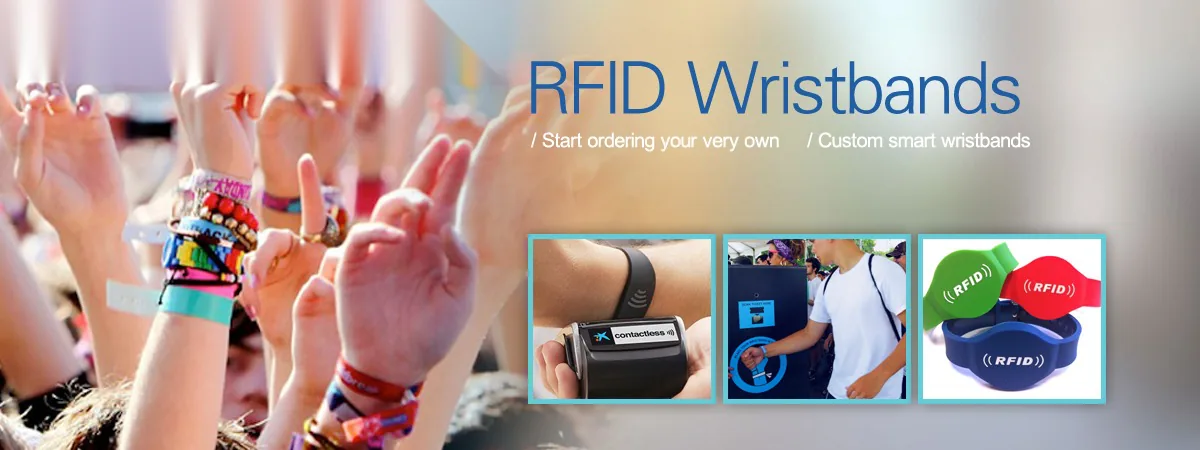
They are both RFID — the difference is range
"NFC wristband" and "RFID wristband" are often used as if they were opposites, but NFC is itself a type of HF RFID. What really separates event wearables is the frequency band, because that sets read range, whether a phone can read the band, and how the system is built.
HF/NFC bands operate at 13.56 MHz and are read within roughly 1–10 cm — a deliberate tap. UHF bands operate at 860–960 MHz and can be read from 1–5 metres or more, which suits hands-free gate reads and locating attendees, but needs dedicated readers rather than phones.
How each is used at an event
HF/NFC is the default for cashless payment and access: a guest taps the band at a bar, gate or activation, and (because NFC is built into phones) the same chip can power social check-ins and tap-to-win games. UHF shines where you want to read many bands at once from a distance — automatic entry lanes, zone counting and real-time crowd flow — without anyone tapping.
NFC (HF) vs UHF event wristbands
| Aspect | NFC / HF band | UHF band |
|---|---|---|
| Frequency | 13.56 MHz | 860–960 MHz |
| Read range | ≈ 1–10 cm (tap) | ≈ 1–5 m+ |
| Phone-readable | Yes | No (needs reader) |
| Best for | Cashless pay, access, social | Gate flow, crowd tracking |
| Chip examples | NTAG, MIFARE | UCODE, Impinj |
| Interaction | Deliberate tap | Hands-free / bulk |
Choose NFC/HF when
Your priority is cashless spend, secure access and phone/social interaction — festivals, conferences, VIP and brand activations. This is the most common event setup because it is secure at close range and works with the phones guests already carry.
Choose UHF when
You need to read many attendees automatically from a distance — high-throughput entry lanes, timing, or live zone-occupancy analytics at large venues. UHF is usually paired with fixed gate readers.
Sourcing both
We manufacture both HF/NFC and UHF wristbands in silicone, fabric and Tyvek, pre-encoded to your system, so you can match the band to the use case (or run a dual-frequency band) and get one branded, ready-to-issue batch. Tell us your event size and interactions and we will recommend the chip and material.
Related reading
Frequently asked questions
Is an NFC wristband the same as an RFID wristband?
NFC is a short-range subset of HF RFID (13.56 MHz). All NFC bands are RFID, but "RFID wristband" can also mean a longer-range UHF band. The practical difference is tap range vs metres of range.
Which is better for cashless payment at events?
HF/NFC wristbands are the standard for cashless payment — secure at tap range and readable by phones and bar terminals. UHF is used more for hands-free gate access and crowd tracking.
Can one wristband do both payment and gate tracking?
Yes — a dual-frequency band combines an HF/NFC chip for tap-to-pay with a UHF chip for long-range gate reads. Tell us your workflow and we will advise.