By RFID MFG Editorial Team · Updated August 12, 2026 · 2 min read
What an inlay is
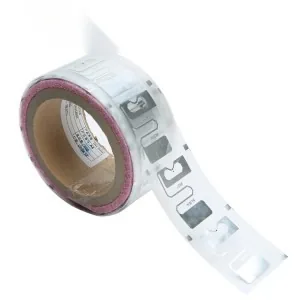
An RFID inlay is the working core of a smart label: an antenna with the chip attached, on a thin substrate. Whether it is "dry" or "wet" simply describes whether adhesive has been applied — and that decides how you convert it into a finished product.
Dry vs wet inlay
| Property | Dry inlay | Wet inlay |
|---|---|---|
| Adhesive | None | Pressure-sensitive adhesive |
| Use | Laminate / embed into product | Peel and stick directly |
| Typical buyer | Label converters, card makers | End users, packers |
| Cost | Lower (no adhesive) | Slightly higher |
| Format | Reel | Reel, ready to apply |
Choose a dry inlay when
You manufacture your own labels, cards or tickets and will laminate the inlay between layers, or embed it into a product. Dry inlays give converters maximum flexibility and the lowest cost.
Choose a wet inlay when
You want to apply tags directly to products, cartons or documents with no extra converting step. Wet inlays peel off the liner and stick down immediately, ideal for retail and logistics tagging.
How inlays become finished products
A dry inlay is the input for converters: it gets laminated between a printed face and a backing to become a card, ticket or hang tag, or embedded inside a product. A wet inlay skips a step — it is laminated to a printable face and a release liner to become a white RFID label, which an RFID printer then prints and encodes before it is peeled and applied. The face stock (paper or PET), antenna size and liner are all specified to match your printer and application surface.
Chip options inside an inlay
The inlay is where you choose the chip. UHF inlays commonly use NXP UCODE 8/9 or Impinj M730/M750 for long-range item and carton tracking; HF/NFC inlays use NTAG or ICODE for tap and library use. Antenna designs are tuned to the chip and to whether the item is paper, plastic, glass or near metal.
Related reading
Frequently asked questions
What is the difference between a dry and wet RFID inlay?
A dry inlay has no adhesive and is meant for laminating or embedding; a wet inlay has a pressure-sensitive adhesive so it can be peeled and stuck directly onto an item.
Which inlay do label printers use?
RFID label printers typically use white-faced wet inlays (printable RFID labels) so the label can be printed and encoded, then applied in one step.
What chips come in RFID inlays?
UHF inlays typically use NXP UCODE 8/9 or Impinj M730/M750; HF/NFC inlays use NTAG or NXP ICODE. We match the chip and antenna to your read range, surface and budget.
Can inlays be pre-encoded?
Yes, both dry and wet inlays can be supplied blank or pre-encoded to your numbering scheme.