By RFID MFG Editorial Team · Updated September 1, 2026 · 2 min read
The risk it addresses
As contactless payment, smart ID and access cards become universal, so does the theoretical risk of "skimming" — an unauthorized reader trying to read a card through a bag or pocket. RFID blocking neutralises that by interfering with reads at 13.56 MHz.
Passive vs active blocking
Passive shielding uses conductive material to absorb and detune the reader field, needing no power. Active cards contain a tiny circuit that emits a disrupting signal when it senses a read attempt. Both stop nearby contactless cards from being read silently.
Cards, sleeves and wallets
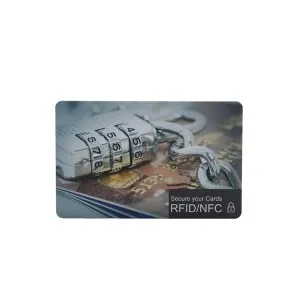
A blocking card sits in a wallet and protects the cards around it. Sleeves wrap individual cards or passports. Wallets and card holders build the shielding into the lining for everyday protection. All can be branded — popular as bank and corporate giveaways.
What blocking does — and does not — do
RFID blocking stops contactless reads at 13.56 MHz: contactless bank cards, access badges, and the chip in e-passports. It is honest to note that modern EMV contactless payment already has cryptographic protections that make real-world skimming difficult, so a blocking product is best framed as added peace of mind rather than the only defence. Blocking does not affect the magnetic stripe or contact chip, and a single blocking card only protects cards stored close to it.
How to test a blocking product
You can verify a shield in seconds. Place a contactless card behind the blocking card, sleeve or wallet panel and try to read it with an NFC phone or a desktop reader; a working shield prevents the read, while the same card reads instantly when removed. For production QA we test every design against a calibrated 13.56 MHz reader so branded giveaways actually perform, not just look the part.
Blocking options
| Product | How it protects | Best for |
|---|---|---|
| Blocking card | Shields the whole wallet | Banks, promotions |
| Sleeve | Wraps one card/passport | Travel, giveaways |
| Wallet / holder | Shielded lining | Everyday carry |
Related reading
Frequently asked questions
Does RFID blocking really work?
Yes — a properly made passive shield or active jamming card prevents nearby contactless cards from being read at 13.56 MHz. Independent of brand, the physics of shielding the field is sound.
Do I need to block every card?
One blocking card or a shielded sleeve/wallet protects the contactless cards stored with it; very large wallets may benefit from a shield on each side.
Can blocking cards be branded?
Yes, they are fully printable and widely used as bank and corporate promotional gifts.
Does an RFID blocking card affect my phone or car key?
No. Blocking products only shield cards stored right next to them at 13.56 MHz. They do not affect your phone, or a car key fob, which uses different frequencies and needs to transmit freely.