By RFID MFG Editorial Team · Updated August 12, 2026 · 3 min read
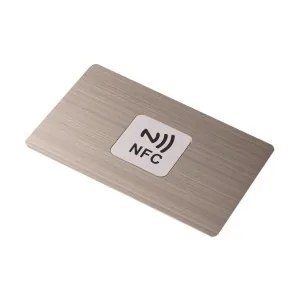
They are related, not rival, technologies
One of the most common questions in the industry is whether to use "RFID" or "NFC". The short answer: NFC is a type of RFID. Both use radio waves and passive tags powered by the reader. The difference is range, interaction model and ecosystem.
NFC operates only at 13.56 MHz, works at a few centimetres, supports two-way communication, and is built into virtually every smartphone — making it ideal for tap-to-share, authentication and marketing without an app. "RFID" as a category also includes LF and UHF, and is typically a one-way identification system optimised for range and bulk reading.
How they work — and why NFC is really "HF RFID"
Every RFID and NFC system pairs a reader, an antenna and a passive tag. The reader radiates an electromagnetic field; the tag harvests that energy to power its chip and reply — no battery required. NFC uses the same 13.56 MHz HF band as HF RFID and follows the same core air-interface standards — ISO/IEC 14443 and ISO/IEC 15693 — plus ISO/IEC 18092 for the peer-to-peer mode that lets two phones exchange data. That shared foundation is why NFC is best understood as a consumer-friendly branch of HF RFID rather than a separate technology.
The practical split is range and direction. Passive HF/NFC reads at roughly 1–10 cm and can exchange data both ways; passive UHF RFID (860–960 MHz) reads up to about 10 metres and is built to read hundreds of tags per second in a single pass. That is why supply-chain, retail inventory and warehouse gates run on UHF, while tap-to-pay, access control and product authentication run on HF/NFC.
RFID vs NFC
| Aspect | NFC | RFID (general) |
|---|---|---|
| Frequency | 13.56 MHz only | LF, HF or UHF |
| Range | ≈ up to 4 cm | Up to ~10 m (UHF) |
| Communication | Two-way | Mostly one-way |
| Phone support | Built into smartphones | Needs a dedicated reader |
| Reads many tags at once | No | Yes (UHF) |
| Best for | Tap marketing, auth, access | Inventory, logistics, tracking |
When to choose NFC
Choose NFC when end users will tap with a phone: product authentication, tap-to-reorder packaging, smart posters, digital business cards and tap-to-pay. No app or pairing is needed because NFC is native to the phone.
When to choose broader RFID
Choose UHF RFID when you need to read many items quickly from a distance — retail stock counts, warehouse gates, asset tracking. Choose LF for animal ID or access near metal. These need a dedicated reader rather than a phone.
Cost, volume and sourcing
For item-level tagging at scale, passive UHF inlays are usually the lowest cost per piece, while NFC labels and cards cost a little more but unlock phone interaction. As a manufacturer we supply both families — NTAG, MIFARE and DESFire for HF/NFC, and NXP UCODE and Impinj for UHF — with low MOQs, free samples and custom encoding. If you are unsure which fits, tell us the use case and volume and we will recommend the chip, frequency and format and quote within 24 hours.
Related reading
Frequently asked questions
Can a smartphone read RFID?
Smartphones can read NFC (HF 13.56 MHz) tags natively. They cannot read LF or UHF RFID without an external reader accessory.
Is NFC less secure than RFID?
Security depends on the chip, not the category. Both NFC and RFID offer secure chips (e.g. DESFire) with encryption; short NFC range also limits eavesdropping.
Which is cheaper, NFC or UHF RFID?
For high-volume item-level tagging, UHF inlays are usually the cheapest per tag; NFC labels cost a little more but enable phone interaction.
Do NFC or RFID tags need a battery?
No. Standard NFC and passive RFID tags are unpowered — they harvest energy from the reader field. Only active UHF tags used for long-range tracking carry a built-in battery.