By RFID MFG Editorial Team · Updated August 12, 2026
For decades warehouses relied on barcodes, which must be scanned one at a time and in direct line of sight. RFID removes both limits: a single fixed or handheld reader can capture hundreds of tagged items per second through cartons and packaging, so receiving, put-away, picking and cycle counts all move faster.
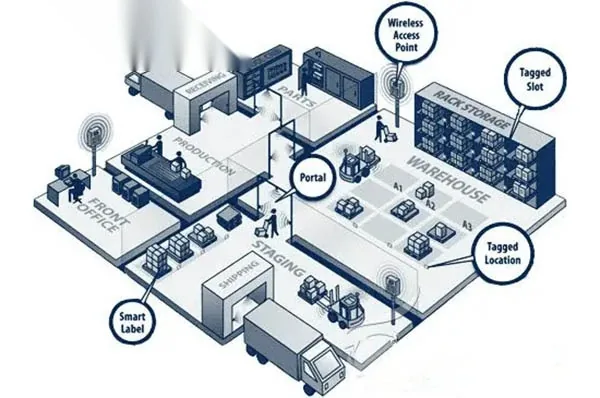
In a typical deployment, UHF RFID labels are applied to cartons or pallets, antennas are mounted at dock doors and aisle gateways, and reads flow into the warehouse management system (WMS) in real time. Staff stop hand-scanning every item and instead see what arrived, what shipped and what is on each shelf automatically.
Barcode vs RFID in the warehouse
| Aspect | Barcode | RFID |
|---|---|---|
| Line of sight | Required | Not required |
| Items per read | One | Hundreds at once |
| Typical range | A few cm | Up to ~10 m (UHF) |
| Re-writable data | No | Yes |
| Stock-count speed | Slow, manual | Fast, bulk |
Key takeaways
- Bulk, no-line-of-sight reads speed up every inbound and outbound step
- Real-time inventory accuracy reduces shrinkage and stockouts
- UHF (860–960 MHz) is the usual choice for pallet and carton range
- Tags, labels and readers integrate with most WMS platforms
How RFID MFG helps
RFID MFG supplies the UHF inlays, labels, hard tags and reader hardware that make warehouse visibility possible — pre-encoded to your numbering scheme and tested for your packaging and read environment.
Related products & guides
Frequently asked questions
Which frequency is best for warehouses?
UHF (860–960 MHz) is standard for pallet and carton tracking because of its longer read range and fast bulk reads. HF/NFC suits item-level tagging at short range.
Can RFID integrate with our WMS or ERP?
Yes. Readers output data over USB, RS232/485, Wi-Fi or Ethernet, and middleware feeds it into common WMS/ERP systems.