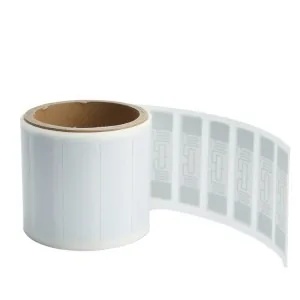
UHF RFID Labels for Inventory & Logistics
UHF RFID label rolls for retail items, cartons and inventory workflows. Specify the item, reading setup and printing process so the label construction, roll format and encoded data fit the job.
- UHF 860–960 MHz
- NXP UCODE®
- Impinj
Start with your item and reader or printer model. If the chip is not yet selected, describe the read zone and sample test you need.
About UHF RFID Label
The inlay combines a chip and antenna; the finished label adds its face, adhesive and liner. Choose the construction around the item and placement, including nearby metal, liquid or dense packs. For an in-house print-and-encode line, reader performance and printer compatibility are separate checks: a label that reads well on an item must also feed and encode correctly in that printer.
For deployments in more than one country, list the markets and the reader configurations. Confirm the selected inlay coverage and reader settings for each setup. For a retailer or customer program, supply the current written specification and any required inlay approval; a chip family alone does not demonstrate acceptance.
Need phone tapping on packaging? Compare printed NFC labels. For metal assets, review on-metal RFID tags. For your own printing line, also see white printable RFID labels.
Who will print and encode the labels?
Agree which operation happens at the factory and which happens on your line. Pre-encoded data still needs verification after printing and application.
| Workflow | Specify before sampling | Check on the trial roll |
|---|---|---|
| You print and encode | RFID printer model, media specifications, label pitch, inlay position and data scheme | Media and RFID calibration, feeding, print registration, encoding verification and reject handling |
| You print; labels arrive encoded | Allocated EPC records, printed fields and how the correct record is matched at print time | Printed-to-encoded matching, roll sequence and how voided or reprinted labels are reconciled |
| Labels arrive printed and encoded | Artwork, variable fields, data mapping, packing groups and applicator requirements | Print legibility, encoded record, adhesion and reading after application to the actual item |
If you print in-house, send the exact printer model and media specification: width, length, pitch, gap or mark sensing, core, maximum roll diameter and winding direction. Include the printing method and ribbon where applicable. Check media feeding and printing on a sample roll; if you also encode in the printer, confirm inlay position and RFID calibration using its manufacturer's instructions. For finished labels, specify manual application or the applicator requirements.
Printed barcode text and EPC data need not be identical strings. Agree how the application maps each printed identifier to its encoded record, including replacement labels and reprints.
Turn the requirements into a repeatable pilot
Include with your inquiry
- Quantity by label design, item or packaging material, contents and planned label position.
- Reader and antenna models, installation countries and the required read zone, including movement or packed-item reading.
- Printer or applicator model, label dimensions and roll format; state who prints and who encodes.
- EPC scheme, serial allocation owner and printed barcode or text mapping. Describe the format before sharing production files.
- Any retailer or project specification, sample acceptance criteria, delivery destination and needed date.
Approve the complete workflow
- For in-house printing, check media calibration, feeding and print quality at the planned speed. If encoding in the printer, also perform RFID calibration and record encoding failures.
- Compare printed identifiers with the encoded EPC and receiving-system record. Reconcile rejected and reprinted labels before releasing the batch.
- Apply labels to representative items, including filled containers and packed cartons where relevant.
- Test the agreed reader setup, orientation, movement and tag density. Record both missed reads and unwanted reads from outside the zone.
- Confirm adhesion, print durability, roll quantities and packing against the approved sample and acceptance criteria.
Keep a trial record of label/inlay model, item and placement, reader setup, attempts, successful reads and rejected labels, plus printer settings when applicable. Use the same conditions when comparing samples.
Order UHF RFID Label by the roll — factory direct
Buy UHF RFID Label by the roll at factory pricing — from 1,000 pcs per order, converted, tested and shipped in 7–12 days. Sample rolls ship free first so you can verify read performance on your own printer and surfaces. Indicative pricing is $0.05–$0.28 per pc and drops steeply at 10k+ volumes, with OEM die-cuts and pre-encoding available.
- MOQ 1,000 pcs
- From $0.05/pc
- Free samples
- OEM / ODM
Guide pricing from our published range — the exact quote depends on chip, size and artwork, and lands in your inbox within 24 hours. T/T · worldwide shipping. Full range: RFID price guide.
Get Exact Quote for 1,000 pcs →Why this product
- UHF label constructions selected for the item and read zone
- Blank, pre-encoded or printed-and-encoded workflows
- Printed identifiers mapped to the agreed EPC records
- Trial rolls for printer, application and reader checks
Built to your spec
- Inlay — chip, antenna, band coverage and any project approval requirements
- Label — face, adhesive, shape and placement for the intended item
- Roll — dimensions, inlay position, core and winding for the production equipment
- Data — EPC scheme, serial allocation, printed fields and verification
- Delivery — quantities by design, roll identification and packing groups
Technical details
| Frequency | UHF; select inlay band coverage within 860–960 MHz for the reader and deployment markets |
|---|---|
| Air interface | EPC Gen2 / ISO/IEC 18000-63; confirm the selected chip and reader configuration |
| Chip options | Impinj M730 / M750 or NXP UCODE 9, by selected inlay |
| Read performance | Verify the finished label on the intended item, with the project reader, antenna, settings and read zone |
| Face / adhesive | Coated paper or PET options; specify printing method, surface and exposure |
| Roll format | Confirm label size and pitch, inlay position, core, outside diameter and winding for the printer or applicator |
| Encoding | Blank or pre-encoded; agree the EPC scheme, serial allocation and print-to-encoded ID mapping |
All specifications are customizable — tell us your requirements. Full datasheet: HTML · PDF.
Third-party product and brand names are trademarks of their respective owners, shown for compatibility identification only; no affiliation or endorsement is implied.
Where it's used
- Retail apparel
- Warehouse
- Supply chain
- Inventory
Our factory, in numbers
| Production | UHF label printing, encoding and converting; roll format and data requirements agreed per order |
|---|---|
| Chip sourcing | Direct from NXP, Impinj and EM Microelectronic product lines |
| Engineering | In-house R&D, tooling and QC lab |
| Frequencies | LF 125 kHz · HF 13.56 MHz · UHF 860–960 MHz |
| Shipping | Worldwide express, with full export documentation |
| Quality system | ISO 9001 · ISO 14001 · ISO 45001 — certificate number, issuing body and certified scope on request |
| Product compliance | CE / FCC declarations issued per product model and target market |
| Material compliance | RoHS / REACH statements issued per material and batch |
| Warranty | 2 years, with free pre-production samples |
Labels and inlays are converted reel-to-reel in-house — antenna bonding, adhesive lamination, die-cutting and 100% read/write testing on the same line — so every roll arrives printer-ready, with samples first and a 2-year warranty.
From inquiry to delivery
Chip, size, artwork, quantity — or just the goal. We reply with an exact quote within 24 hours.
Free pre-production samples in 3–5 days plus an artwork proof, so you verify material, print and chip.
Bulk production starts only after you approve the sample and proof — 7–12 days in house.
Express door-to-door shipping worldwide, with a 2-year warranty and ongoing support.
Frequently asked questions
What read range will our UHF labels achieve?
The result depends on the finished inlay, item and contents, placement, reader, antenna and settings. Define the required read zone and test representative tagged items in the actual process. A chip name or a best-case distance does not establish performance for the whole project.
Can you supply pre-encoded EPC labels?
Blank or pre-encoded labels are available. For pre-encoding, agree the data scheme, authorized serial allocation and any printed barcode or text mapping before producing samples. Validate the sample records in your receiving system before approving the batch.
Can a phone read these UHF labels?
A phone NFC reader does not directly read an ordinary UHF label. Use a compatible UHF reader for inventory. If the intended action is a customer phone tap, choose a suitable NFC label and test it on the finished pack.
Will the same label work with every RFID printer?
Do not assume compatibility from the chip name or label width. Confirm the printer model, supported media and tag types, inlay position and roll format. Check media calibration and print quality; when encoding in the printer, also run its RFID calibration as instructed. Validate the proposed roll at the intended settings.
Do all UHF projects need SGTIN-96?
No. The data scheme comes from the application or customer specification. If SGTIN is required, agree the valid product identifiers, serial format and allocation ownership, including coordination with existing orders and other suppliers. Approve sample records before volume encoding.
What should we provide about keys and encoding data?
For quoting, describe the record format, allocation process and any locking requirements. Before sharing production records or access credentials, agree the transfer method, authorized access and retention requirements with the project team.
What minimum order does UHF RFID Label carry?
1,000 pcs is the standard starting volume; configuration changes can shift it, so share your numbers and we will confirm.
How is UHF RFID Label priced at volume?
Expect roughly $0.05–$0.28 per pc FOB Shenzhen before volume breaks — final pricing follows your exact spec and quantity.
Related products
- ISO 9001
- ISO 14001
- ISO 45001
- CE
- FCC
- FSC
- RoHS
- REACH
Get a wholesale quote for UHF RFID Label
Tell us your chip, size, artwork and quantity — we reply within 24 hours.