By RFID MFG Editorial Team · Updated August 12, 2026
The challenges
- Inventory records that drift from reality, causing missed sales
- Out-of-stocks and overstocks from inaccurate counts
- Shrinkage and theft at the shelf and exit
- Slow, labour-heavy manual stock takes
- Errors in buy-online / ship-from-store fulfilment
How RFID helps
Each item is tagged at source with a low-cost UHF RFID label or hang-tag carrying a unique EPC. Staff cycle-count a whole rail or shelf in seconds with a handheld reader, and overhead or exit readers flag stock movement and theft in real time.
Because every unit is individually identified, the same data drives store replenishment, online availability and ship-from-store — so the customer sees accurate stock wherever they shop.
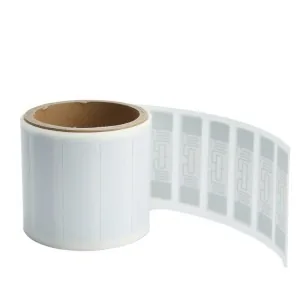
Rollout is straightforward when the tags are right. Apparel and general merchandise use UHF paper labels or hang-tags; small, high-value items such as jewelry and cosmetics use miniature or on-metal tags; and many retailers specify a combined RFID-plus-barcode label so existing POS keeps working through the transition. As a manufacturer we supply these pre-encoded to your EPC/SGTIN scheme and printed with your artwork, so tags arrive ready to apply at source or in the DC.
Benefits
- Inventory accuracy rises from an average of 63% to 95% (Auburn RFID Lab)
- Cycle-count time cut by 96% versus manual barcode counts (Auburn RFID Lab)
- Out-of-stocks fall, lifting sales of in-demand lines
- Shrink is reduced with EAS at the exit
- Reliable omnichannel (BOPIS / ship-from-store) fulfilment
Typical impact
| KPI | Before | With item-level RFID | Source |
|---|---|---|---|
| Inventory accuracy | 63% (average) | 95% | Auburn RFID Lab |
| Cycle-count time | Baseline | Down 96% | Auburn RFID Lab |
| Out-of-stock rate | Baseline | Down up to 50% | Auburn RFID Lab |
| Order accuracy (DC to retailer) | 31% of orders error-free | 99.9% when shipments are reconciled | Project Zipper, Phase 1 |
Sources: inventory accuracy, out-of-stock and cycle-count figures are Auburn University RFID Lab studies as cited in the GS1 US executive summary of the EPC/RFID Retail Supply Chain Data Exchange Study. Order-accuracy figures are from that study itself — “Project Zipper” Phase 1, conducted by the Auburn University RFID Lab and GS1 US between June 2017 and July 2018 across 8 brand owners and 5 retailers. Note that order accuracy and inventory accuracy are different metrics and are not interchangeable. Your own results will depend on tag selection, read infrastructure, product material, store layout and process discipline — we recommend a pilot before full rollout.
Recommended products
UHF RFID Label
Roll-fed smart labels for item-level apparel and retail tagging.
RFID Wet Inlay
Adhesive UHF inlays for fast peel-and-stick tagging.
RFID Jewelry Tag
Tiny UHF tags for high-value jewelry and accessories.
RFID Readers / Writers
Handheld and fixed UHF readers for counts and exits.